
Given Indian corporates's high indebtedness, new credit will be used for servicing loans rather than building factories. This is setting us up for more companies on life support and more zombie banks, warns Rahul Jacob.

In a response to the August 3 order, the Centre, represented by Solicitor General Tushar Mehta, said till the time either the legislature or the poll panel steps in, the top court must lay down "dos and don'ts" for political parties in the 'larger national interest.'

Foreign portfolio investors (FPIs) have pulled out Rs 17,696 crore from the Indian markets in December so far amid uncertainty due to a new coronavirus strain, Omicron, and expectations of faster tapering by the US Federal Reserve. According to the depositories data, FPIs took out Rs 13,470 crore from equities, Rs 4,066 crore from the debt segment and Rs 160 crore from hybrid instruments between December 1-17. In November, FPIs were net sellers to the tune of Rs 2,521 crore in Indian markets.

Top gainers in the Sensex pack were TCS, Bharti Airtel, Infosys, Axis Bank, L&T, ITC, PowerGrid, HCL Tech and Tata Steel, ending up to 2.39 per cent.

Raghuram Rajan, whose current three-year tenure ends on September 4, has already said no to a second term.

'Mumbai main branch (SBI headquarter) has all the data ready-made. It doesn't take even an hour to out the data from the system.'

The 30-share Sensex ended up 248 points at a record closing high of 27,346.

Benchmark indices finished higher on hopes of economic reforms

The rupee on Wednesday declined by 16 paise to close at its fresh lifetime low of 77.60 against the US dollar amid unabated foreign fund outflows and a stronger greenback in overseas markets. At the interbank foreign exchange market, the rupee opened lower at 77.57 and later hit the day's low of 77.61 as the dollar rebounded in global markets following hawkish comments from US Federal Reserve chief Jerome Powell. Crude oil prices also surged over 1 per cent, which weighed on the rupee.

The recent weakness of the rupee has been due to yuan's devaluation.

In a memorable year for the equity market, Dalal Street investors added a whopping Rs 81.90 lakh crore to their wealth in 2023 as a raft of positive factors powered a stellar rally in stocks. Experts said India's strong macroeconomic fundamentals, political stability owing to the BJP's success in recent elections in three significant states, optimistic corporate earnings outlook, signals from the US Federal Reserve about three prospective rate cuts next year and heavy retail investors participation played a major role in fuelling the stock market rally in 2023. In the year 2023, the 30-share BSE Sensex jumped 11,399.52 points or 18.73 per cent.

Markets slumped for fourth straight session this Monday as investors braced for the central bank meeting with caution.

The market capitalisation of BSE-listed companies reached an all-time high of Rs 261.73 lakh crore on Thursday, helped by a massive rally in the equities where the benchmark Sensex zoomed 958 points to end at a fresh lifetime peak. The 30-share BSE benchmark jumped 958.03 points or 1.63 per cent to settle at its new closing peak of 59,885.36. During the day, it gained 1,029.92 points to touch an intra-day record high of 59,957.25.

Benchmark Sensex declined 224 points on Wednesday, snapping its four-session winning streak, mainly due to sell-off in IT and pharma counters amid rising concerns over possible aggressive interest rate hikes to tame high inflation. The 30-share index rebounded more than 1,200 points from the early lows before settling at 60,346.97 points, a total loss of 224.11 points or 0.37 per cent compared to Tuesday's closing level. The broader NSE Nifty closed lower 66.30 points or 0.37 per cent at 18,003.75 points.

India Inc is borrowing from global firms as interest rates sky rocket in India.

There has been a stellar rise for the Indian markets this far in calendar year 2021 (CY21) with the S&P BSE Sensex surging over 19 per cent. The gain in mid-and small-cap indices on the BSE has been sharper with both these indexes surging around 38 per cent and 54 per cent, respectively during this period. Rampant spread of Covid pandemic's Delta variant and the ensuing lockdown and mobility curbs across India, rising prices key commodities, including crude oil and its impact on inflation, possibility of tightening of policy stance by major global central banks, especially the US Federal Reserve (US Fed) have been some of the key headwinds that the markets successfully negotiated during this period.

'Investors should focus on largecap funds, flexicap funds, business cycle funds, or hybrid-category funds.'

The deficit data was the latest in a run of positive signs for the sluggish domestic economy and could put India in a better position should the Fed start tapering, than in the summer when the rupee hit a record low.

RBI likely to cut rate early next year.
.jpg)
The rupee has avoided the heavy losses suffered by some emerging Asian currencies such as the Philippine peso this year because of its efforts to narrow the current account deficit, and strong foreign investor inflows.

The S&P BSE Sensex plunged 461 points to end at 25,603.

There are already some signs of stress in this market.
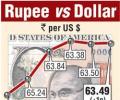
The rupee ended higher for the second consecutive week.

'We are not entirely out of the woods.' 'The broader trajectory remains tentative.' 'However, we may expect some near-term bounce.'

The US Fed on May 24 hinted at withdrawing its third round of quantitative easing, or bond buying programme, worth $85 billion each month, which began in the wake of the worst credit crisis in September 2008.

Both the government as well as the RBI took a series of steps to curb imports of gold and other non-essential items in addition to increase foreign exchange inflows.

As Indians scrambled to exchange the banned notes for new currency, Paytm, Sharma's digital payments startup, went on a promotional spree, inviting Indians to start using Paytm's digital wallet to pay for everyday goods and services.

On Monday, Reserve Bank hiked the lending rates to banks by 2 per cent to 10.25 per cent.

Historically, March has been a volatile month for Indian equity markets. To begin with, it marks the end of a financial year, wherein there is some compulsive portfolio rebalancing trade by large funds - domestic and foreign. Retail investors, too, prefer to 'cash in' on their gains and losses before the financial year runs out.

India has been relatively insulated from the severe headwinds in the West. However, with a third of the global economy expected to slip into recession in calendar year 2023, the impact will strongly be felt on India's exports and trade economy, leading economists said in a panel discussion at the Business Standard BFSI Insight Summit in Mumbai on Wednesday. The panel comprised former Reserve Bank of India executive director and former Monetary Policy Committee member Mridul Saggar, State Bank of India Chief Economic Advisor Soumya Kanti Ghosh, Citibank India Chief Economist Samiran Chakraborty, ICRA Chief Economist Aditi Nayar, and IndusInd Bank Chief Economist Gaurav Kapoor. The topic of the panel discussion was No recession in sight: Is India decoupled from developed economies?

Tech Mahindra was the top gainer in the Sensex pack, rising around 2 per cent, followed by Bharti Airtel, Maruti, ICICI Bank, SBI, HDFC Bank, Asian Paints and Reliance Industries.

Federation of Indian Chambers of Commerce and Industry said the Reserve Bank's step may make availability of funds through external commercial borrowing route more expensive.

The staff of public sector banks had gone on a nationwide strike for two days beginning February 10 after discussions with the IBA failed.

Equity investors became poorer by over Rs 6.71 lakh crore on Thursday as domestic benchmark indices tumbled amid a global market meltdown. The 30-share BSE benchmark Sensex tanked 1,416.30 points or 2.61 per cent to settle at 52,792.23, tracking weak global markets and persistent foreign fund outflows. In line with the weak market trend, the market capitalisation of BSE-listed firms tumbled by Rs 6,71,051.73 crore to stand at Rs 2,49,06,394.08 crore.

After a volatile session, Sensex closed the day 563 points lower

Monday saw the Sensex post its weakest closing since July 11 when it settled at 36,265.93. In the previous four sessions the index had lost 1,249.04 points.

Shaktikanta Das is a master of the finest balancing act who listens to all but takes his own decisions, discovers Tamal Bandyopadhyay.

The Union government will soon make amendments to the foreign trade policy (FTP) to enable exporters to claim export benefits for settling trade in rupees. These benefits are, so far, available for export payments received in foreign currencies. After the Reserve Bank of India (RBI) unveiled a mechanism to settle international trade transactions in the local currency on Monday, exporters have been demanding that the Ministry of Commerce and Industry come up with a clarification on the matter.

Foreign investors pumped in Rs 11,119 crore in the Indian equities in December, making it the second consecutive monthly inflow, despite increasing concerns over the re-emergence of Covid-19 cases in some parts of the world. However, foreign portfolio investors (FPIs) have turned cautious in recent days. The inflow in December was much lower compared to Rs 36,239 crore invested by FPIs in the month of November, data with the depositories showed.

Foreign portfolio investors (FPIs) infused Rs 11,630 crore in the Indian equity markets in April on the reasonable valuation of stocks and appreciation in the rupee. This came after FPIs infused a net sum of Rs 7,936 crore in equities in March, mainly driven by bulk investment in the Adani Group companies by the US-based GQG Partners. However, if one adjusts for the investments of GQG in Adani Group, the net flow was negative.
